Trump foreign licensing income surged to $59.5 million

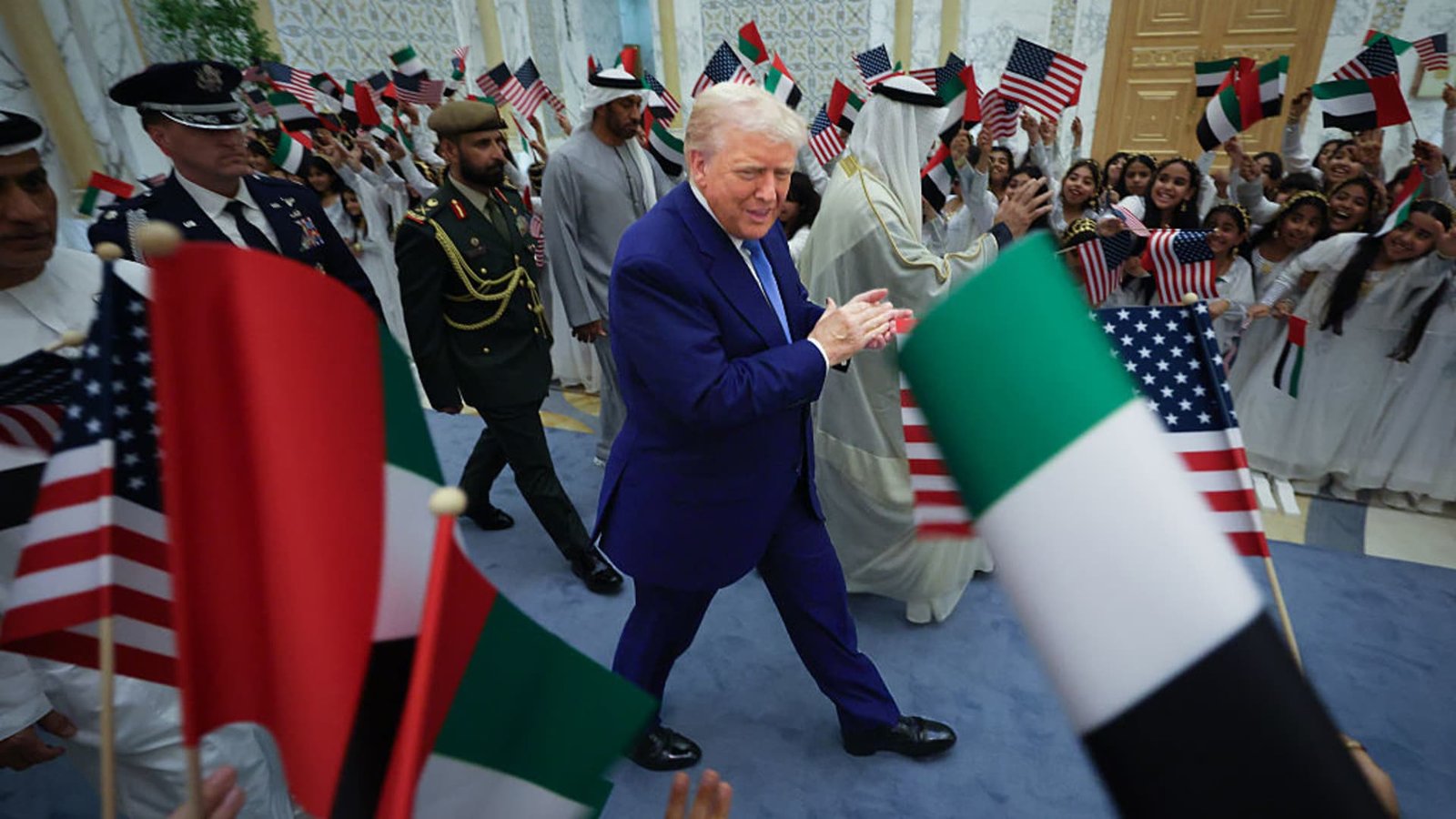
President Donald Trump at an official arrival ceremony at Qasr al Watan, or Palace of the Nation, in Abu Dhabi, United Arab Emirates, May 15, 2025.
Win Mcnamee | Getty Images
President Donald Trump’s foreign real-estate licensing business boomed during his first year back in office, generating $59.5 million in 2025 as international developers paid a premium to brand luxury towers, golf courses and coastal resorts with the Trump name.
Foreign licensing revenue, including for the use of the Trump name on properties around the world, rose 71% from 2024. The sum was nearly 10 times higher than in 2023, according to a CNBC analysis of Trump’s annual financial disclosure — fueled by the Trump Organization’s reversal of the company’s first-term pledge to pursue “no new foreign deals whatsoever.”
The Trump Organization’s second-term ethics policy bars new material transactions with foreign governments but allows deals with private foreign companies
Four Trump-affiliated licensing LLCs not listed in his 2024 disclosure generated $20.25 million in 2025, accounting for 82% of the increase. Five other licensing LLCs that had previously been listed as inactive generated another $9.64 million.
More than 60% of the licensing income came from projects in Gulf countries.
Some of those developers licensing the Trump name were pursuing major U.S. investments, seeking government permits or pressing for favorable economic and diplomatic relations. Other Trump-branded projects relied on state-owned land, sovereign investment or partnerships with government-controlled companies.
The result, ethics watchdogs told CNBC, is an unprecedented collision between the president’s public power and private wealth. The deals also raise unresolved questions, legal experts told CNBC, about the Constitution’s Foreign Emoluments Clause.
CNBC found no evidence that any licensing payment influenced an administration decision, that a developer received special treatment or that Trump intervened on a company’s behalf.
The Trump Organization told CNBC it operates “completely separate from the presidency,” complies with ethics and conflict-of-interest laws and uses an outside ethics adviser to avoid conflicts. The Trump Organization did not respond to questions about specific projects involving foreign licensing.
Asked about Trump’s foreign dealmaking, a White House spokesperson did not address the arrangements directly. The spokesperson said “the only special interest guiding” Trump’s decisions is “the best interest of the American people” and pointed to more than $2 trillion in investment commitments and commercial, defense, aviation and technology deals announced during the president’s May 2025 Gulf trip.
“Foreign governments and politically connected businesses now have a direct, incredibly visible way to put money into the sitting president’s pocket,” said Scott Greytak, deputy executive director of Transparency International U.S., an anti-corruption nonprofit.
“The conflict is already in plain sight right now,” Greytak told CNBC. “We don’t need to wait for some kind of smoking gun to see a quid pro quo.”
Eric Trump told The New York Times in 2024 that the family “did everything imaginable to avoid any appearance of impropriety” and “got crushed anyway.” He continued, saying, “We can’t just sit out in perpetuity, and I won’t.”
Donald Trump was blunter about the foreign deals, telling The Times in January, “I found out that nobody cared. I’m allowed to.”
Gulf developers expand in the U.S.
Projects linked to the United Arab Emirates generated roughly $22 million in licensing income for Trump in 2025, followed by Saudi Arabia with $9 million and Qatar with $5 million.
Much of that revenue flowed through two Gulf real-estate developers: Saudi-linked Dar Al Arkan and UAE-based Damac.
Trump reported $25.8 million tied to projects involving Dar Al Arkan and its Dubai-based international arm, Dar Global. Damac-linked projects generated another $11.3 million.
Under the licensing model, local developers generally finance and build the properties, while the Trump Organization collects fees for use of its name and, in some cases, for managing them.
The deals come amid a Gulf-region boom in branded residences, which use luxury and celebrity names to command premium prices. In Dubai, for instance, branded-home transaction volume rose 26% year over year during the first nine months of 2025, while sales value climbed 51%, according to commercial real estate services and investment company CBRE, using its most recent available information.
The Trump name offers something other luxury and celebrity brands cannot: the suggestion of access to the power of the presidency.
Critics like Ben Freeman, director of the Democratizing Foreign Policy program at the Quincy Institute for Responsible Statecraft, said being associated with Trump’s brand can signal political access when a developer — or its government — has interests before Washington. The think tank advocates for diplomacy rather than military intervention.
“Is this an America First foreign policy, or is this a Trump First foreign policy?” Freeman told CNBC.
President-elect Donald Trump listens as Damac Properties CEO Hussain Sajwani speaks to members of the media during a press conference at the Mar-a-Lago Club in Palm Beach, Florida, Jan. 7, 2025.
Scott Olson | Getty Images
Damac offers an example of that overlap, ethics experts said.
Its $11.3 million in licensing payments included two newly disclosed $5 million fees tied to Damac’s Abu Dhabi projects, even though the Trump Organization has no active developments there. That is possible because developers can pay for the contractual right to use the Trump brand before a project is built — including through up-front or milestone-based fees.
The payments came as Damac, founded by billionaire Hussain Sajwani, pursued a major U.S. expansion.
In January 2025, Sajwani joined then president-elect Trump at Mar-a-Lago to announce plans to invest at least $20 billion in U.S. data centers. Trump praised the commitment and said companies investing at least $1 billion would receive expedited environmental and regulatory reviews.
Sajwani, a longtime friend of Trump, told CNBC at the time that “the sky is the limit” when it came to U.S. investment.
Six months later, Trump signed an executive order directing federal agencies to accelerate permitting for qualifying data centers and the energy infrastructure supporting them.
The policy applied broadly, and Damac soon advanced a major data-center project that could qualify for expedited federal permitting and other support under the order.
By December, a Damac subsidiary had paid another $36.5 million for land near Canton, Ohio, for a proposed data center, county property records show. The same eight-parcel property had changed hands for $8.55 million just two days earlier, according to the records. The project will require coordination with local officials on power, water and other infrastructure.
“A developer whose project depends on federal permitting and energy policy has a direct financial interest in the administration’s decisions,” Greytak said.
Canton city spokesperson Christian Turner told CNBC in a statement that Damac Digital is “subject to the same requirements as any other developer.” The project remains under review, and no incentives have been approved, Turner said.
Dar Al Akan and Damac did not respond to multiple requests for comment.
CNBC found no evidence that any of Damac’s payments influenced the executive order or that Trump intervened on the company’s behalf. Still, ethics experts said the overlapping financial and policy interests create at least the appearance of a conflict.
“It seems as though this Damac project was padding the president’s private business to help grease the wheels for data centers affected by Trump policies,” said Kedric Payne, ethics director at the Campaign Legal Center, which promotes government ethics and adhering to anti-corruption laws.
“When presidential decisions appear directly connected to his financial interests, you have, at the very least, the appearance of an ethics problem,” Payne said.
Last week, CNBC reported Sajwani’s son, Abbas Sajwani, had bought the megayacht Amadea from the U.S. government for $187 million. The vessel was seized as part of sanctions on Russian oligarchs and was previously valued at more than $300 million.
Private deals, public backing
Other Persian Gulf projects raise a different set of conflict questions.
In Qatar and Oman, the Trump Organization signed licensing agreements with private developers rather than directly with foreign governments. Both projects, however, involve state-controlled entities. The Trump Organization’s ethics policy bars only direct agreements with foreign governments. In practice, both projects rely on state-controlled land, investment or partners.
The Quincy Institute’s Freeman said the line between a private developer and a foreign government can be “meaningless in many cases” in the Gulf.
“The largest stakeholders can be the royal families, or they might be sitting on the board,” he said. “There are almost always enormous entanglements between the governments and corporations cutting these deals, even if they’re ostensibly private.”
Trump disclosed $5.25 million in licensing income tied to Dar Global’s plans for a Trump-branded golf club and luxury villas in Qatar. The project, however, is part of the Simaisma coastal development led by Qatari Diar, a real estate investment company established by Qatar’s sovereign wealth fund and chaired by the country’s municipality minister.
The disclosed payments also coincided with a major expansion in U.S.-Qatar ties. Dar Global and Qatari Diar announced the Trump-licensed project April 30, 2025, two weeks before Trump visited Doha, during the first major foreign-policy trip of his second term, and announced major aviation, defense and economic agreements with Qatar.
“The concern is not that these deals prove a quid pro quo,” Greytak said. “It is that Qatar was putting money into the president’s business while seeking major agreements from his administration, raising unavoidable questions about whose interests shaped the relationship.”
CNBC found no evidence that the Trump project influenced any of those agreements.
The Qatari government and Qatari Diar did not respond to questions about whether the Trump project was discussed alongside the new U.S. agreements.
Eric Trump, executive vice president of the Trump Organization, looks over a model of a development ahead of a signing ceremony with Qatar’s Diar and Dar Global in Doha on April 30, 2025.
Karim Jaafar | Afp | Getty Images
The Oman project has a similar structure, pairing a private developer with a state-owned partner.
Trump reported nearly $1 million in licensing income tied to Aida, a development being built through a joint venture between Dar Global and Omran Group, the Omani government’s tourism-development arm.
The Omani government and Omran Group did not respond to detailed questions about its state-owned company’s role in the project or its involvement in the Trump licensing agreement.
Reported foreign licensing revenue also extended beyond the Gulf.
In Vietnam, Trump reported $5 million tied to a planned golf development outside Hanoi valued at $1.5 billion that advanced while Vietnamese officials were negotiating with the Trump administration to avoid a threatened 46% tariff.
Then-Prime Minister Pham Minh Chinh joined Eric Trump at the project’s May 2025 groundbreaking and said Eric Trump’s visit had “motivated us to expedite this project.”
“It’s hard to say that there’s a coincidence when official decisions happen so close in time to the family business receiving financial benefits,” Payne said.
CNBC found no evidence that the Trump project influenced the tariff negotiations or the rate imposed on Vietnamese goods.
The Vietnamese government did not respond to questions about whether the project was discussed during the negotiations or why officials expedited its approval.
Eric Trump, son of President Donald Trump, shakes hands with Vietnam Prime Minister Pham Minh Chinh during the groundbreaking ceremony for the Trump International, Hung Yen resort and golf course project in Hung Yen province on May 21, 2025.
Str | Afp | Getty Images
Emoluments concerns
Together, the Qatar and Oman projects raise unresolved questions, legal experts tell CNBC, under the Constitution’s Foreign Emoluments Clause, which bars federal officeholders from accepting certain benefits from foreign states without congressional consent.
“The central issue is whether payments routed through a private developer can still be attributed to a foreign state when a government-controlled company owns the land, finances the project or participates in its development,” said Scott Anderson, a Brookings Institution senior fellow and Lawfare blog general counsel and senior editor.
Courts have never definitively resolved that question. The Supreme Court dismissed several first-term lawsuits accusing Trump of violating the clause as moot after Trump left office in 2021, without ruling on the merits.
“Obviously, the framers didn’t anticipate licensing fees,” Anderson, a former legal adviser at the U.S. Embassy in Baghdad, told CNBC. But its “pretty broad scope” suggests officials should not benefit from foreign governments without congressional approval, he said.