Learning the power pattern of Support Resistance and Trend line [best]

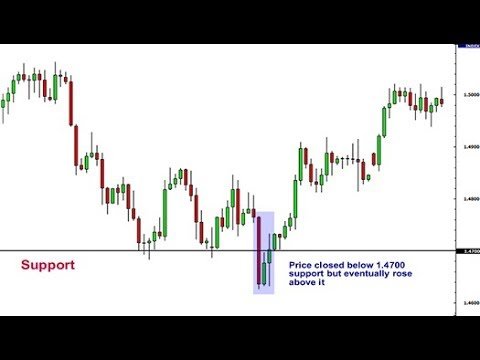
In this case, the price had closed below the 1.4700 support level but ended up rising back up above it.
If you had believed that this was a real breakout and sold this pair, you would’ve been seriously hurtin’!
Looking at the chart now, you can visually see and come to the conclusion that the support was not actually broken; it is still very much intact and now even stronger.
To help you filter out these false breakouts, you should think of support and resistance more of as “zones” rather than concrete numbers.
One way to help you find these zones is to plot support and resistance on a line chart rather than a candlestick chart. The reason is that line charts only show you the closing price while candlesticks add the extreme highs and lows to the picture.
These highs and lows can be misleading because often times they are just the “knee-jerk” reactions of the market.
It’s like when someone is doing something really strange, but when asked about it, he or she simply replies, “Sorry, it’s just a reflex.”
When plotting support and resistance, you don’t want the reflexes of the market. You only want to plot its intentional movements.
Looking at the line chart, you want to plot your support and resistance lines around areas where you can see the price forming several peaks or valleys.
Other interesting tidbits about forex support and resistance:
When the price passes through resistance, that resistance could potentially become support.
The more often price tests a level of resistance or support without breaking it, the stronger the area of resistance or support is.
When a support or resistance level breaks, the strength of the follow-through move depends on how strongly the broken support or resistance had been holding.
With a little practice, you’ll be able to spot potential forex support and resistance areas easily.
In the next lesson, we’ll teach you how to trade diagonal support and resistance lines, otherwise known as forex trend lines.
Next Lesson
Trend Lines
Elementary
Sign in to unlock progress tracking.
View All Courses
Grade 1
Support and Resistance Levels
Forex Support and Resistance
Trend Lines
Channels
How to Trade Support and Resistance
Summary: Trading Support and Resistance
Grade 2
Japanese Candlesticks
What is a Japanese Candlestick?
Japanese Candlestick Anatomy
Basic Japanese Candlestick Patterns
Single Candlestick Patterns
Dual Candlestick Patterns
Triple Candlestick Patterns
Japanese Candlestick Cheat Sheet
Candlesticks with Support and Resistance
Summary: Japanese Candlesticks
Grade 3
Fibonacci
Fibonacci Trading
How to Use Fibonacci Retracement to Enter a Trade
Fibonacci Retracements are NOT Foolproof
How to Use Fibonacci Retracement with Support and Resistance
How to Use Fibonacci Retracement with Trend Lines
How to Use Fibonacci Retracement with Japanese Candlesticks
How to Use Fibonacci Extensions to Know When to Take Profit
How to Use Fibonacci to Place Your Stop so You Lose Less Money
Summary: Fibonacci Trading
Grade 4
Moving Averages
What Are Moving Averages?
Simple Moving Average (SMA) Explained
Exponential Moving Average (EMA) Explained
Simple vs. Exponential Moving Averages
How to Use Moving Averages to Find the Trend
How to Use Moving Average Crossovers to Enter Trades
How to Use Moving Averages as Dynamic Support and Resistance Levels
Summary: Using Moving Averages
Grade 5
Popular Chart Indicators
How to Use Bollinger Bands
How to Use the MACD Indicator
How to Use Parabolic SAR
How to Use the Stochastic Indicator
How to Use RSI (Relative Strength Index)
How to Use ADX (Average Directional Index)
Ichimoku Kinko Hyo
Trading with Multiple Chart Indicators
What is the Best Technical Indicator in Forex?
Summary: Popular Chart Indicators
Schools of Pipsology
Your Overall Progress Report
Lessons Completed
168
of
source