How to Read Japanese Candlestick Charts (Part I)

✅ Free Trial, Tradenet Trading Room: https://bit.ly/2YruEtX
✅ Free $10,000 Trading Challenge: https://bit.ly/3DVJ1XG
✅ “The Market Whisperer” Book, Free Part 1: https://bit.ly/2Vn5Hik
✅ Learn To Trade Stocks: https://bit.ly/2YyPnfC
✅ Learn To Trade Crypto: https://bit.ly/3h4jJgk
✅ Tradenet Plus: https://bit.ly/38HpHiK
Join Our Facebook Group: https://bit.ly/3BNyHPW
Follow My Social Media:
Instagram: https://bit.ly/3DTcr8X
Twitter: https://bit.ly/2WZK48y
Facebook Page: https://bit.ly/3DUs1kE
TikTok: https://bit.ly/3h7dOay
Twitch: https://bit.ly/3yOKZFC
Stocktwits: https://bit.ly/3zPi8SR
Refer A Friend, Get Rewarded: https://bit.ly/3kWn6XX
Visit Our Website: https://bit.ly/3zKY0Br
Contact Us: https://bit.ly/3h4kMNi
#StockMarket #Trading #DayTrading
How to Read Japanese Candlestick Charts (Part I):
If you wish to become a day trader, you need to learn how to read Japanese Candlestick charts, because day traders use the “Japanese candlesticks” charting method almost exclusively. This method was developed by Munehisa Homma (1724-1803), a Japanese rice trader who was the first to make use of past rice prices to predict future prices. And the method really worked! Munehisa became extremely wealthy from the rice trade, and he was so highly esteemed that he obtained honorary samurai status. Someone calculated that Munehisa earned the modern-day equivalent of $10 billion in a single year, with a cumulative capital of $100 billion!
The principles of the Japanese candlesticks charting method were studied in the 1970s by several technical analysts, and primarily by Steve Nison, who also wrote a bestseller on the method. The result is that the Japanese candlestick method still serves us well, nearly three centuries after it was invented.
Once You Learn How to Read Japanese Candlestick Charts, You Will Know How to ‘Feel’ a Stock
It is very important to learn how to read a Japanese candlestick chart, because such charts allow experienced day traders to “understand” the changing prices across an axis of time, much as a musician hears music when seeing notes. Just as this advanced stage of comprehension allows musicians to “live within the body” of the notes, it allows traders to “feel” a stock, to sense the fear and greed of buyers and sellers, and to know how to take advantage of this information for their own benefit.
Below is a typical “daily” Japanese candlestick chart (that is, a chart showing daily price intervals) for a period of 16 trading days. Each candlestick, or “candle” for short, represents one entire day of trade. In this example, we have labeled three different types of candles:
• [1] a day of falling prices
• [2] a day of rising prices
• [3] a day of no change
At first glance, Japanese candlestick charts appear to be a bit more complicated than simple bar graphs. However, they are really quite simple.
Japanese Candlesticks Graphically Represent Price Movement
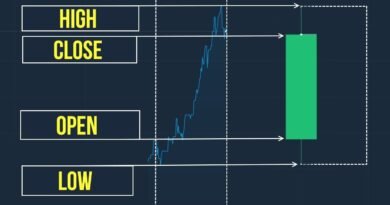
Each candlestick has a “body” that graphically represents the movement of prices over a specific interval of time—a minute, day, a month, or even a year—chosen by the trader. Look at the two candlesticks below and note the following:
• The top and bottom parts of the body show the opening and closing prices.
• When the candle body is clear (i.e., white or transparent) or filled with green, it indicates that the closing price was higher than the opening price. In other words, the price rose during the represented time frame.
• When the candle body is filled with black or red, it means the closing price was lower than the opening price. In other words, the price dropped.
Most, but not all, of the candles have at least one “tail,” also known as a “wick” or “shadow,” extending from either end of the body. Look at the candlestick below and note the following:
• A tail extending from the upper end of the body is called a topping tail, and it marks the highest price reached for the time frame represented by the candlestick (for example, the day’s high).
• A tail extending from the lower end of the body is called a bottoming tail, indicating the lowest price for the specific period.
Please see Part II of this topic to learn more about reading Japanese candlestick charts.
source