How to Read a Stock’s ‘Behavioral Profile’

Editor’s Note: Most investors think the market is random — or at least unpredictable.
But look closer, and you’ll notice that no stock is aimless. Each follows a hidden rhythm: a deeper behavioral “tell” that can be decoded the same way a seasoned coach studies an opponent or a profiler studies human behavior.
My colleague Keith Kaplan has spent years building systems to detect those hidden patterns. As CEO of TradeSmith, he’s now using AI to map the unique “behavioral profile” of thousands of stocks — identifying the specific conditions that have historically led to big moves.
In today’s guest essay, Keith explains how this approach works — and why it’s giving investors a new kind of edge in today’s fast-moving market.
He’ll break it all down in his upcoming AI Signals Trading Event on Wednesday, April 22, at 10 a.m. Eastern.
If you’d like to see how it works — and what it’s flagging in the market today — you can reserve your spot and get access here.
Bill Belichick knows things about opposing quarterbacks that they don’t even know themselves.
Belichick coached the New England Patriots for more than two decades and won six Super Bowls. But it wasn’t just the wins that made him a legend – it was also the preparation behind them.
Every week, before facing a new team, he built a behavioral profile of its key players. Not just the obvious tendencies – like where a quarterback liked to throw on third and long or how he handles pressure – but also the really granular stuff.
How a QB responds to cold weather. Whether he holds the ball longer on turf than on grass. How a particular referee’s calls shape his decisions.
FBI profilers built an entire discipline around the same idea. Study anyone carefully enough, and their behavioral patterns become visible — and predictable. Not perfectly… but enough to act on.
Most investors don’t realize it. But every stock has its own behavioral profile, too – its own habits, quirks, and tells.
Once you learn how to read that profile, the market looks less like a random system and more like a place where patterns govern what happens next.
At TradeSmith, my team and I have spent more than a year developing a new type of pattern-extracting trading tool. One that builds a behavioral profile of more than 2,000 stocks and scans them every day for the specific patterns that have historically preceded big moves.
I’ll show you how it works in a moment, and how it’s found recurring patterns with historical accuracy rates of 90% and higher. I’m also giving you a chance to test drive a beta version of our software ahead of our upcoming launch event.
First, if you don’t know us already, some background on TradeSmith.
21 Years of Learning to Read the Market’s Tells
We’re a leading financial technology company based in Baltimore.
As CEO, I run a team of 65 people, and an annual budget of $8 million, to develop hedge-fund-level analytical systems for self-directed investors.
More than 134,000 people in 86 countries use our software to manage more than $29 billion in assets. And we’re always innovating, which is what’s gotten us featured in Forbes, The Wall Street Journal, and The Economist.
Inside our Research Lab, we’re like modern-day prospectors panning for gold, only we use data and computers, not pans and pickaxes. We’re constantly testing algorithmic trading strategies, market health indicators, and analytics to uncover what actually works – and what doesn’t.
You may have heard of our risk-management software, TradeStops. It takes the emotions out of investing by showing you the ideal time to sell your stocks.
We’ve also created software tools that spot hidden seasonality patterns in stocks… find undervalued options plays… and use AI to forecast stock moves up to 21 trading days out.
But this time, we haven’t just created a revolutionary piece of trading software. We’ve also created a whole new way to think about markets.
Each Stock Has Its Own Story
We all know there are different ways to analyze stocks and select trades. The main two are fundamental analysis and technical analysis (also known as chart analysis).
With fundamental analysis, you look at what a company is worth and whether the market is pricing it correctly. Warren Buffett made this method famous. It works. But it applies the same framework to every company, as if they all behave the same way.
With technical analysis, you look at how a stock is trading rather than what the business is doing. It also works. But like fundamental analysis, it also applies the same frameworks to thousands of different companies.
Then there’s a game-changing third approach that we’ve been working on at TradeSmith.
Where fundamental analysis asks what a company is worth and technical analysis asks how its stock has been trading, our approach asks something different entirely.
How does this specific stock behave – and when does that behavior signal a big move?
We call it Behavioral Profile Analysis (BPA). And it changes how you think about trading…
This Changes How You See Stocks
At the foundation of BPA is the simple observation: Every business in the world is unique.
This means every stock has its own way of behaving and its own way of reacting to what happens in the economy and the markets.
For example, a tech company like Oracle Corp. (ORCL) will behave differently than an oil producer like Chevron Corp. (CVX). And a big drug company like Pfizer Inc. (PFE) will behave differently than a retailer like Macy’s Inc. (M). Those are four very different business models.
When you look at the markets this way, stocks start to resemble people. Each one has its own behavioral patterns — its own habits, tendencies, and quirks.
The same economic event hits two companies differently. The same market development triggers two different reactions. And underneath it all, each stock leaves behind a distinct trading “thumbprint.”
But most of those thumbprints are invisible to the human eye.
That’s why the system we developed evaluates 2.09 million potential trades every day across 2,467 stocks. It runs each one through hundreds of calculations, looking for the specific combinations of factors that have historically preceded big moves.
We tested this strategy from every angle. Here’s what we found…
When These Factors Align, Gains Tend to Follow
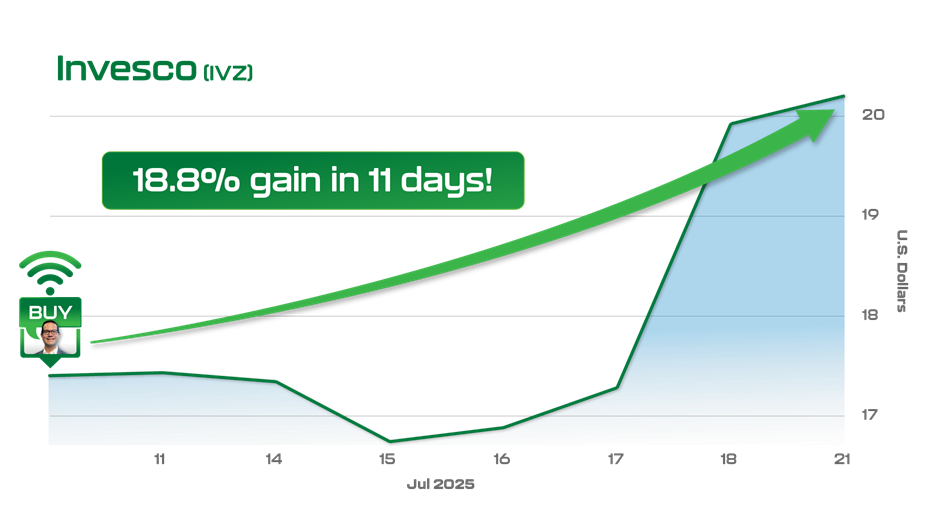
Invesco Ltd. (IVZ) is one of the world’s largest investment management firms.
We ran it through our system and found that two factors had to align for IVZ’s signal to fire. The stock’s Bollinger Percent B and its Money Flow Index both had to exceed 80.
Bollinger Percent B measures where a stock’s price sits relative to its recent trading range. The Money Flow Index tracks whether money is flowing into or out of the stock.
No human analyst would’ve cracked this specific pattern because nobody would ever think to look for it.
But this signal produced an 18.8% gain in 11 days.
For Lam Research Corp. (LRCX), one of the largest makers of semiconductor manufacturing equipment, the pattern was different.
Two different factors had to align for this signal to fire. The stock had to close above its 200-day moving average. And that close had to fall exactly two trading days before a market holiday.
Nothing about the company’s earnings… about the semiconductor sector… or about the broader market. Just a price condition and a calendar condition, lining up at a specific moment.
That’s it.
When the signal fired on August 28, 2025 — two trading days before Labor Day — LRCX gained 11.4% in 15 days.
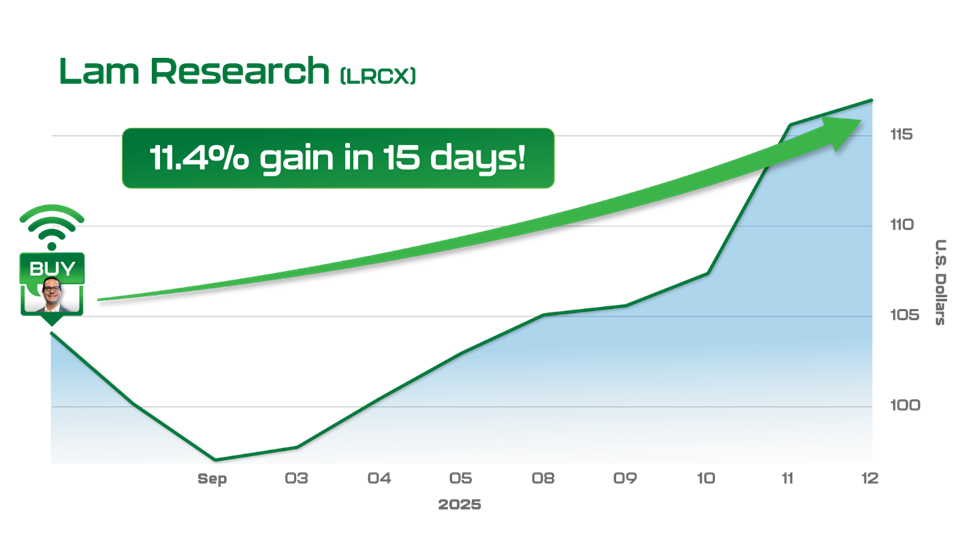
The historical accuracy rate behind that signal was 86%.
And we didn’t stop there.
In January and February, we also ran a live beta test using these same signals internally. And the results were just as powerful.
These Live Test Results Blew Us Away
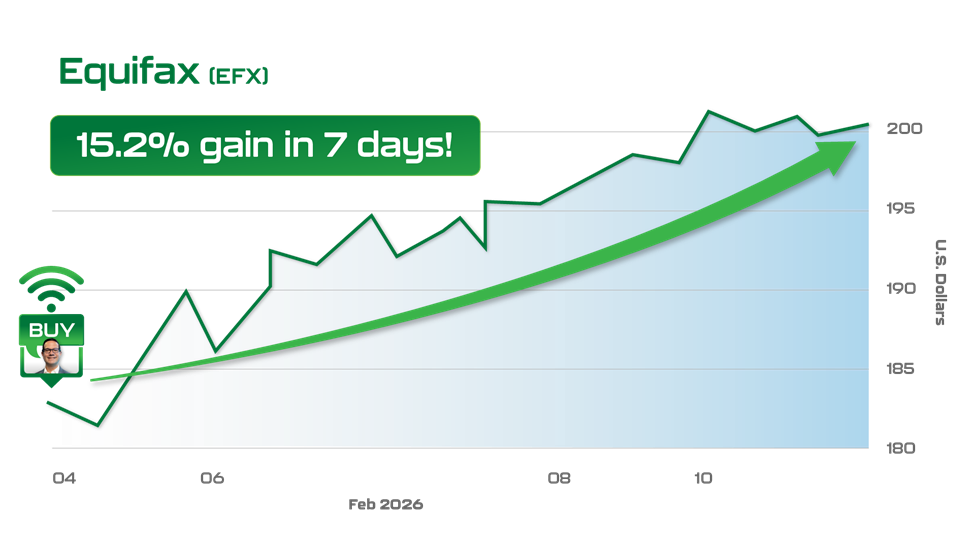
One of our beta test trades was on Equifax Inc. (EFX). It’s one of America’s largest consumer credit reporting agencies.
Again, two factors had to align for this signal to fire. The stock had to close down four consecutive days. And market volatility had to rise above its 10-day average.
When both conditions aligned, the result was a 15.2% gain in seven days — against a 91% historical accuracy rate.
With these examples, we were trading our signals with stocks.
When we applied our signals to options trades, the results included:
- Caterpillar Inc. (CAT): 126% in 72 hours
- Nvidia Corp. (NVDA): 129% in 5 days
- Lockheed Martin Corp. (LMT): 365% in 30 days
- HCA Healthcare Inc. (HCA): 461% in 13 days
- Generac Holdings Inc. (GNRC): 1,082% in 33 days
We’ve invested more than a year’s work… and millions of dollars… into this system. But as you can see, the results are worth it. We’ve created the most advanced analytical platform in our firm’s 21-year history.
And because it looks at the world in a way that more than 99% of investors never think of, it gives you a powerful edge.
It’s thinking differently… trading differently… and delivering market-beating trades as a result.
You can find out all about it at my AI Signals Trading Event on Wednesday, April 22, at 10 a.m. Eastern.
I’ll walk you through the technology behind it – and the trades it’s flagging for the weeks ahead.
In the meantime, take it for a test drive. By registering for the event here, you’ll get immediate access to the final beta version ahead of the launch.
I hope to see you there.