
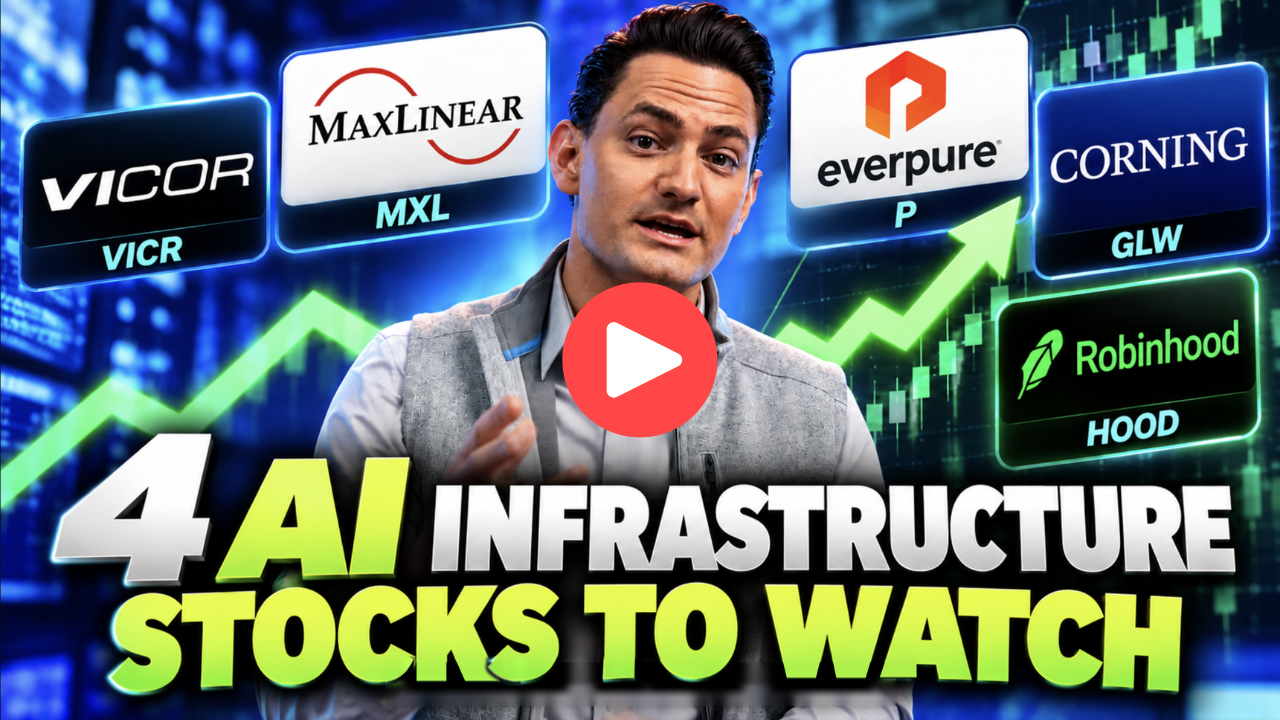
Don’t Miss These 4 Stocks in the AI Infrastructure Race

The next wave of opportunities across AI infrastructure, connectivity, storage, and fintech are here
Listen to the audio version of this article (generated by AI).
On Sept. 29, AT&T Inc. (T) and Corning Inc. (GLW) announced a multiyear agreement worth more than $3 billion.
The product at the center of that deal?
Glass.
Specifically, the optical fiber that carries data through communications networks. The agreement supports AT&T’s fiber expansion as internet usage and AI increase demand for faster connections.
Now, this is a broadband deal. It is not a $3 billion order for AI data centers. But it highlights something investors should understand about the AI economy: Every digital breakthrough creates physical demands.
More data needs more places to travel. More processors need more electricity. More AI applications need faster access to stored information.
And the companies solving those problems could become some of this market’s biggest winners.
The challenge is finding them before investors fully appreciate their role, and buying them at a price that leaves room for upside.
Corning says AI data centers require more than 10 times as much optical fiber as traditional facilities. That does not automatically translate into 10 times the revenue. It does reveal how dramatically the infrastructure requirements are changing.
That is where I see opportunity.
In this week’s Being Exponential with Luke Lango, Brooke and I examine four companies addressing those infrastructure needs, plus a fifth stock positioned for a potential crypto recovery. We also tackle the question that matters after you identify a great business:
When is the stock actually worth buying?
Let’s find out.
Vicor: Solving the Last Inch of the Power Problem
Most conversations about AI electricity demand focus on power plants and the grid.
But getting electricity to a data center only solves part of the problem. You still have to deliver that power efficiently to the processors inside.
That is where Vicor Corp. (VICR) enters the picture.
AI processors require enormous current at very low voltage. Moving that current across a circuit board creates heat and wastes energy. Vicor’s vertical power delivery technology shortens the delivery path, reducing losses near the processor.
Think about the economics.
A company spending billions on computing equipment has every reason to squeeze more useful work out of each watt. As processors become more demanding, the value of efficient power delivery increases.
Vicor can pursue that opportunity through hardware and intellectual property licensing.
The investment thesis connects revenue growth with expanding profit margins. When sales grow faster than operating expenses, earnings can grow faster than sales.
That is a powerful combination. But the price you pay still matters.
In the episode, I explain why Vicor’s business attracts me — and why an overbought stock can call for patience even when the long-term thesis looks excellent.
MaxLinear and Corning: Building AI’s Data Highways
An AI cluster contains thousands of processors working together.
Those processors need to exchange information quickly and reliably. Otherwise, expensive computing capacity sits waiting for data.
MaxLinear Inc. (MXL) supplies chips that keep those connections working.
Its digital signal processors help high-speed links transmit and recover data. Its Keystone products serve 400G and 800G connections, while Rushmore addresses the move to 1.6 terabits per second. That progression increases the amount of information a connection can carry.
Why does that matter for investors?
Because the AI buildout creates recurring upgrade opportunities. As computing demands increase, customers need faster networking equipment.
For a smaller supplier, winning more business in that expanding market can produce substantial growth. It also creates execution risk: Customers have to adopt the products, and the company has to deliver.
Corning approaches the same opportunity from another direction. It supplies the fiber connecting processors, racks, buildings, and campuses.
Put simply, MaxLinear supplies silicon inside the connections. Corning supplies the glass carrying the signals.
Both benefit from the need to move more information.
I am particularly interested in this networking opportunity as AI adoption expands from training models to using them. That everyday use, called inference, happens whenever a model generates an answer, analyzes a document, or completes another task.
As those workloads spread, the entire system matters: processors, networking, storage, and the CPUs coordinating work around the accelerators.
The opportunity keeps broadening.
Everpure: Putting Corporate Data to Work
A business does not gain much from an AI assistant that cannot access the information needed to do its job.
Your sales assistant needs customer records. Your research assistant needs documents. Your internal chatbot needs company knowledge.
That creates an opportunity for Everpure Inc. (P), formerly Pure Storage, which provides storage and data management technology.
The more businesses incorporate their own information into AI applications, the more valuable fast, reliable access becomes.
Everpure’s FlashBlade platform addresses that storage performance challenge. The investment thesis centers on growing demand from both large cloud operators and enterprises deploying AI across their businesses.
In the episode, we examine how sustained revenue growth and improving margins could translate into faster earnings growth.
But there is another lesson here.
A stock holding near its highs while other technology names struggle can signal underlying business strength. You still need to examine valuation and expectations. Yet strength alone is not a reason to dismiss a company.
My approach: Identify the business you want to own, then stay disciplined about the entry.
Robinhood: A Different Kind of Growth Catalyst
Our fifth stock takes us beyond AI infrastructure.
Robinhood Markets Inc. (HOOD) offers exposure to trading activity, including cryptocurrency. My bullish case rests partly on a potential renewed expansion in crypto participation.
The mechanism is straightforward.
Rising crypto prices can attract more traders. More participation can generate more transactions. That activity can benefit the platform facilitating it.
Robinhood is also pursuing a broader platform spanning multiple markets, including prediction markets.
But this thesis has clear pressure points.
A stalled crypto recovery would weaken the catalyst. Regulatory restrictions could constrain prediction markets. And weaker consumer activity could reduce trading.
In the podcast, we examine the Bitcoin chart informing my outlook and the evidence that could challenge it.
A Great Business Still Needs a Good Entry
Across these stocks, I keep returning to one setup: a long-term winner that pulls back, stabilizes, and begins advancing again.
An upward-sloping 200-day moving average can provide context for that longer trend. The relative strength index, or RSI, helps assess recent momentum; readings above 70 commonly indicate overbought conditions.
Neither indicator guarantees what happens next.
The strongest investment case brings the business, earnings outlook, valuation, and chart together.
That is the work Brooke and I do in the full episode — including the entry zones, chart differences, and risks that a company overview cannot capture.
Watch this week’s Being Exponential for the complete five-stock breakdown and the setups I am watching for the next leg higher.