
CHAOS Economics Is No Longer a Theory

AI job displacement and dollar devaluation are already reshaping markets in real time
Not long ago, I introduced you to what I call CHAOS Economics: the Currency Hollowing And Overautomation Spiral.
It’s the theory that two powerful forces – dollar devaluation and AI-driven job loss – are on a collision course that could hollow out the middle class and dramatically worsen the global wealth inequality crisis.
Companies will increasingly adopt AI models to replace human labor, leading to mass layoffs and weak economic growth, which the government will paper over by printing money. And all that money-printing will lead to a collapse in the value of the dollar. Those who own the AI stack will get richer as a falling dollar and rapid AI adoption push asset prices higher. But everyone else? They will lose their jobs, and the value of the cash in their bank accounts will dwindle as dollars increasingly become worth less and less each year.
Needless to say, whenever I talk about this topic, the response is… spirited. Some think I’m onto something. Others politely suggest I get more sleep.
But here’s the thing about CHAOS Economics: it isn’t just a theory anymore.
In the weeks since I first wrote about the subject, the real world has provided a relentless drumbeat of confirming evidence.
The U.S.-Iran conflict showed that Washington now views AI as a national security asset whose development cannot be meaningfully slowed without strategic cost.
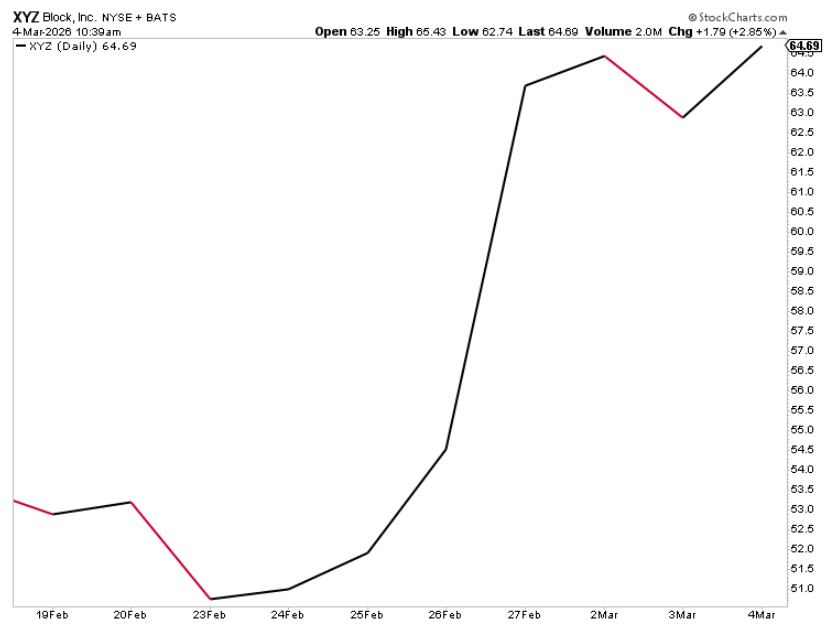
Block Inc. (XYZ) just vaporized 40% of its workforce with an AI rationale.
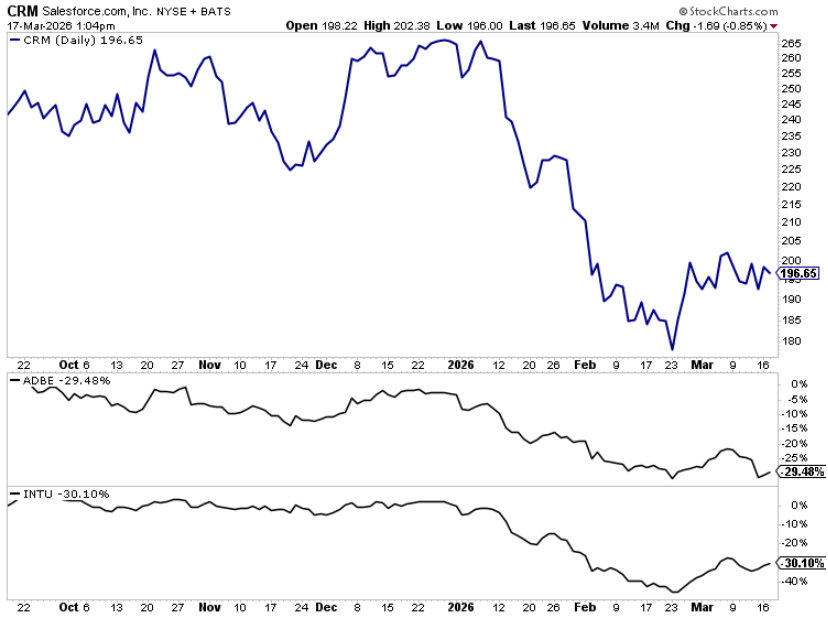
And software stocks like Salesforce (CRM), Adobe (ADBE), and Intuit (INTU) are getting repriced by investors who are doing the math on what AI means for legacy Software-as-a-Service (SaaS) business models.
Let me walk you through it, piece by piece. By the end of this issue, you will understand why the CHAOS spiral isn’t approaching. It’s already underway.
AI Acceleration Became a National Security Priority
There’s one question I’m asked more than any other: “Luke, won’t governments intervene? Isn’t the political pressure to protect jobs going to pump the brakes?”
The Iranian conflict answered that question, emphatically and definitively: No.
Operation Epic Fury was a live-fire demonstration of what AI now means to military decision-making and national power. Autonomous targeting systems. AI-driven logistics and battlefield intelligence. Drone swarms coordinated by machine learning algorithms faster than any human command structure could respond. The side with superior AI-enabled analysis gained a decisive advantage before the first missiles were fired.
Washington is acutely aware that AI supremacy is an existential requirement. A nation that falls behind on AI development does not lose market share. It loses wars, deterrence, and sovereignty.
Think about what this means for the ‘Overautomation’ force in CHAOS. The political accelerator I described in January – the one where Washington floors the pedal because Beijing is close behind – just had rocket boosters strapped to it.
The U.S.-Iran conflict just turbocharged the geopolitical AI arms race. It is now, formally and irrevocably, a national security imperative. Every line of AI regulation that might have slowed deployment is now framed as a threat to American defense readiness.
Just ask Anthropic. After resisting the Pentagon’s demand for unrestricted military use of Claude, it was designated a “supply chain risk” and pushed toward the federal exits.
The Overautomation spiral has a new co-pilot: the U.S. military-industrial complex. Good luck voting that one out of office.
The First Wave of AI Layoffs Has Begun
While the geopolitical theater was playing out overseas, something quieter – though, in many ways, no less significant – happened in San Francisco.
Block Inc. – Jack Dorsey’s fintech conglomerate and the parent company of Square, Cash App, and Afterpay – announced it was cutting roughly 40% of its workforce.
Dorsey’s rationale was direct: AI can now do what humans were doing. The company published internal documentation making clear that agents and automated systems would absorb the functions of the eliminated roles.
This was a deliberate, strategic replacement of human labor with AI labor.
Block didn’t lay off 40% of its people because it was struggling. It did it because it could. That distinction is the entire CHAOS thesis in one corporate action.
Sit with that for a moment because it is going to become the template for the next decade of corporate earnings calls.
The old layoff announcement was a sign of distress: “We missed guidance. We’re trimming headcount, please don’t sell our stock.”
The new layoff announcement is a sign of ambition – “We’ve optimized. We’ve deployed. We’ve found a way to generate the same output with a fraction of the human cost. Our margins are expanding. Buy our stock.”
As Block’s post-announcement stock reaction showed, the market rewarded the efficiency story.
Klarna (KLAR) said AI had taken over work previously done by roughly 700 customer-service agents. Duolingo (DUOL) cut contractors as it pushed further into automation. Atlassian (TEAM) laid off about 1,600 employees while shifting harder toward AI. The list grows every week.
Block is not the first domino. It is simply the loudest one to fall so far.
As AI tools cross the capability threshold where they can replace knowledge workers, companies face an irresistible fiduciary pressure to deploy them. The Microsoft (MSFT) job exposure data I cited in January showed 5 million white-collar roles at high risk. Block just showed what the first wave of that displacement looks like at scale – a press release and a stock bump.
Why AI Is Disrupting SaaS Business Models
If the Block layoffs are evidence of Overautomation, the carnage in software stocks is evidence of something equally important: the market is finally pricing in CHAOS Economics, even if it doesn’t have a name for it yet.
Look at what has happened to the legacy SaaS names. Salesforce, Adobe, Intuit – not long ago, these were considered the blue-chip, untouchable compounders of the software era.
They had sticky products, recurring revenue, and massive customer bases. They were the kind of stocks that boring, sensible portfolio managers tucked away and never thought about again.
Now they are getting hit hard…
Because if an AI agent can do in real time what Salesforce’s CRM platform does – track customers, log interactions, generate follow-up emails, forecast pipeline – why does a company need to pay Salesforce $50,000 a year?
If Adobe’s suite of creative tools can be replicated, extended, and largely automated by generative AI – why does a creative agency need to pay Adobe $10,000 a year per employee?
If Intuit’s TurboTax walks you through a tax return – and a sufficiently capable AI agent can do the same thing, or hire a CPA-level AI to do it for $20 a month – what exactly is Intuit’s moat?
The deflationary tsunami I described in January is arriving on schedule. AI doesn’t just threaten the jobs of the people who use Salesforce. It threatens the business model of Salesforce itself. When intelligence becomes a cheap commodity, the companies that package and sell specific versions of intelligence lose their premium.
We are watching one of the core assumptions of the last 15 years of venture capital – that recurring-revenue SaaS businesses were the closest thing to perpetual-motion machines – get stress-tested by a world where the marginal cost of software capability is collapsing.
The verdict is not pretty for the incumbents. But it is very pretty for the companies building the AI stack that replaces them.
The AI Job Displacement Spiral Explained
Let me bring it all together because this is where the original CHAOS framework gets its live-data update.
Force No. 1 – Overautomation: Confirmed and accelerating. The U.S.-Iran conflict has enshrined AI development as a national security imperative, eliminating any plausible political check on deployment velocity. Block’s 40% workforce reduction has proven that the corporate playbook for AI-driven labor replacement is already operational. The Engels’ Pause – the phase in which productivity rises and GDP grows while wages stagnate for ordinary workers – appears to have begun.
Force No. 2, Currency Hollowing: The setup is unchanged and arguably worsening. The federal deficit continues to expand, and the political appetite for fiscal discipline remains somewhere between minimal and nonexistent. When the unemployment figures begin to reflect the structural labor displacement that is quietly accumulating beneath the surface – and they will – the pressure to print and distribute will be overwhelming. That is not some radical forecast. It is the default playbook governments reach for during major economic disruptions: cushion the shock, suppress the pain, and print if necessary.
The spiral looks like this: More job displacement → more political pressure → more money printing → more asset price inflation → more wealth concentration in the hands of those who own the machines.
In other words, the CHAOS economy is a present condition with a future that grows more extreme by the quarter.
So, where does that leave the lifeboat strategy?
More concentrated than ever. Here is the updated thinking:
The Arms Dealers Are Now Also the Generals
The Iranian conflict has blurred the line between the AI infrastructure companies and the defense industrial base. The companies building the chips, data centers, and inference hardware – Nvidia (NVDA), AMD (AMD), Taiwan Semiconductor (TSM), the hyperscalers – are now dual-use national security assets. That doesn’t just make them investable. It makes them untouchable by regulation. Governments aren’t eager to handicap what they increasingly view as strategic weapons manufacturers.
Avoiding Legacy SaaS Companies
The Salesforce-Adobe-Intuit bloodbath is the market telling us something important: legacy SaaS is the new print media. Don’t own it. The CHAOS portfolio should be built around the companies building the agents and platforms that replace the legacy stack, not the companies defending it.
Why Physical Assets Become More Valuable
In a world of AI-generated abundance in the digital layer, scarcity migrates to the physical – energy, land, water, infrastructure. The data centers that power the AI revolution need gigawatts of reliable baseload power. Nuclear and utilities may not be exciting, but they are essential. And in a currency hollowing environment, real assets backed by real cash flows are the closest thing to a hedge that exists.
The Window to Position Is Closing Fast
When I first introduced the concept of CHAOS Economics, I told you that you had 12 to 24 months before the rest of the world realizes what is happening.
Today, I’m revising that estimate downward.
The Block layoffs made global headlines. The software stock declines are hard to ignore. AI-enabled military operations are now helping shape outcomes in live conflicts. The narrative is leaking out of the financial press and into the mainstream.
The window to position ahead of consensus is closing even faster than it was before.
Most people will still spend the next six months arguing about whether AI is “really” going to take their job. They will look at a low unemployment rate – a lagging indicator by design – and conclude that everything is fine.
It is not.
The Final Word
The structural damage is accumulating faster than the official data can capture it. Block’s announcement was one line in one earnings cycle. Multiply it by a thousand companies making the same quiet calculation over the next eight quarters, and you have a labor market transformation that no jobs report will see coming until it’s already arrived.
The CHAOS spiral rewards those who move early.
My colleague Eric Fry just made a call that suggests we are closer to the first major inflection point than even I expected.
Eric is calling a $10 trillion market shock beginning April 24, 2026 – triggered by a single week of earnings calls from the AI hyperscalers. His thesis isn’t that AI fails. It’s that the physical world can’t keep pace with the digital ambitions of Amazon (AMZN), Microsoft, Meta (META), and Alphabet (GOOGL) – and when their own executives are forced to say the word “constraints” on live earnings calls, the smart money will do the math in real time.
He calls the opportunity on the other side of that shock the “Golden Rivets” – the irreplaceable physical inputs that every data center, every AI chip, and every autonomous system on earth requires to function. Copper. Energy. Memory. The things you can’t conjure with a press release or a model update.
Eric has been here before. He called the dot-com crash. He went on CNBC in 2005 to publicly name the housing bubble. And he told his readers to sell Nvidia in July 2025 and buy Corning – Corning is up 102% since then; Nvidia barely moved.
He’s sharing 15 specific tickers – across raw materials, energy, and dynamic random access memory (DRAM) – in a live event today, March 18 at 1:00 p.m. ET.
If the CHAOS thesis is right, this is the moment the first major wealth rotation begins. The window I told you about is not closing. It is nearly shut.
Don’t be the person who understood the thesis and missed the trade.
Join Eric’s presentation this afternoon to make sure you’re positioned.