The Great Decoupling: How AI Is Rewriting the Labor Market

The global economy as we know it is dying.
Around the beginning of the 18th century, a “Great Divergence” began between ‘the West and the Rest’ – one that tipped the global socioeconomic scales for hundreds of years.
It was an era when industrial innovation, among other things, saw European nations (and their colonized offshoots) enjoy strongly positive GDP growth as Eastern nations’ wealth shrank.
Thanks to inventions like the steam engine, power loom, and cotton gin, the West was able to quickly decouple industrial power from muscle. This shifted human workers’ “value” from their bodies to their brains. And since then, the global economy has functioned on a very simple, linear equation: Human Cognition + Time = Economic Value.
Whether we sought to build a bridge, write a legal brief, or design a next-gen semiconductor, we needed to pay for brainpower. That was the bottleneck.
We became a “knowledge economy.” We told our children that as long as they were smart, went to college, and learned to think, they would always have a seat at the table.
But as AI improves at breakneck speeds, we are now entering a new economic era: the Great Decoupling.
And unlike the “Great Divergence,” where the ‘Rest’ struggled as the West thrived, this is a socioeconomic shift that will negatively impact us all…
AI Job Displacement and the New Era of Jobless Growth
In the first half of the 19th century, during the Industrial Revolution, we saw a phenomenon called Engels’ Pause. It was a 50-year window where the economy grew at record rates, corporate profits doubled, and the stock market soared – but wages for the average worker stayed flat or declined. Why? Because technology was now doing the heavy lifting; and the owners of that tech captured 100% of the gains.
In the Age of AI, Engels’ Pause 2.0 has begun. And this time, it’s on steroids. Just like everything else these days, it is bigger and moving faster than ever before.
Today, the “Great Decoupling” is reflected in a cold, hard statistic: Corporate profits as a share of GDP have surged toward record highs of 11.55%, while labor’s share of the economic pie has plummeted to 53.8%, its lowest levels since the 1940s.
We are entering the era of “Jobless Growth.” Productivity is skyrocketing, but the gains aren’t going to the guy in the cubicle – they’re going to the guy who owns the algorithm. In the Gilded Age, we saw this with steel and rail. Today, we see it with “Centaur Startups.” For example, when Instagram was bought for $1 billion, it had 13 employees. Now AI-native startups are aiming for $100 billion valuations with a headcount you can count on two hands.
If you think a “Universal Basic Income” or a government handout is going to bridge this gap, you’re missing the point. The wealth is being concentrated in the Physical and Compute layers here. It’s being captured by the entities that own the data centers, the energy sources, and the silicon – not the laborers.
The Myth of AI “Augmentation” – And What It Means for Workers
The mainstream media loves the word ‘augmentation.’
“AI won’t replace you; it will just make you more efficient.”
But if we’re being honest, “efficiency” is just a corporate euphemism for “we used to need five of you, and now we only need one.”
What we are seeing with models like OpenAI‘s Codex, Google‘s Gemini, or Anthropic‘s Claude Cowork isn’t just “better software.” It is Recursive Reasoning.
These systems are now able to think through problems, check their own work, and iterate. When cognition becomes a commodity that can be downloaded for $20 a month, the “Knowledge Class” – lawyers, accountants, analysts, coders – becomes the new “Useless Class.”
If AI makes a lawyer five times more efficient, the world doesn’t suddenly need five times more legal briefs. It just needs 80% fewer lawyers.
This is the Arithmetic of Obsolescence.
It’s the reason the “Software-as-a-Service” (SaaS) dream is turning into a nightmare.
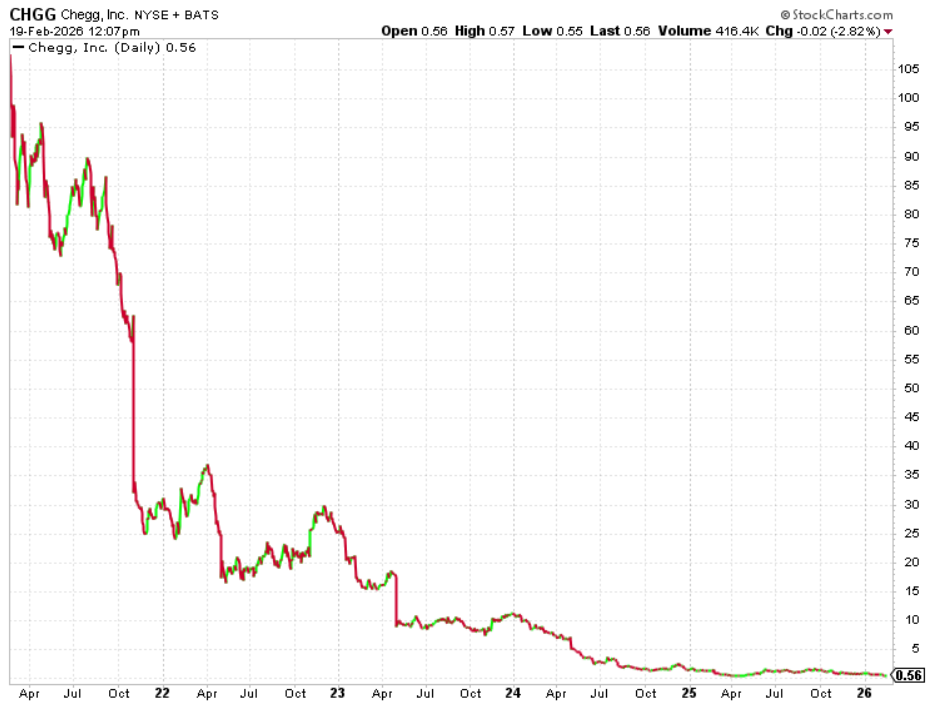
Look no further than Chegg (CHGG). It was the “knowledge toll booth” for students for a decade. Once ChatGPT arrived, that toll booth was bypassed entirely. The business model evaporated overnight, and the stock cratered more than 90%.
The giants aren’t safe, either. Salesforce (CRM) and UiPath (PATH) are built on “seat-based” pricing. But why pay for 1,000 “seats” of software when one AI agent can do the work of 1,000 employees?
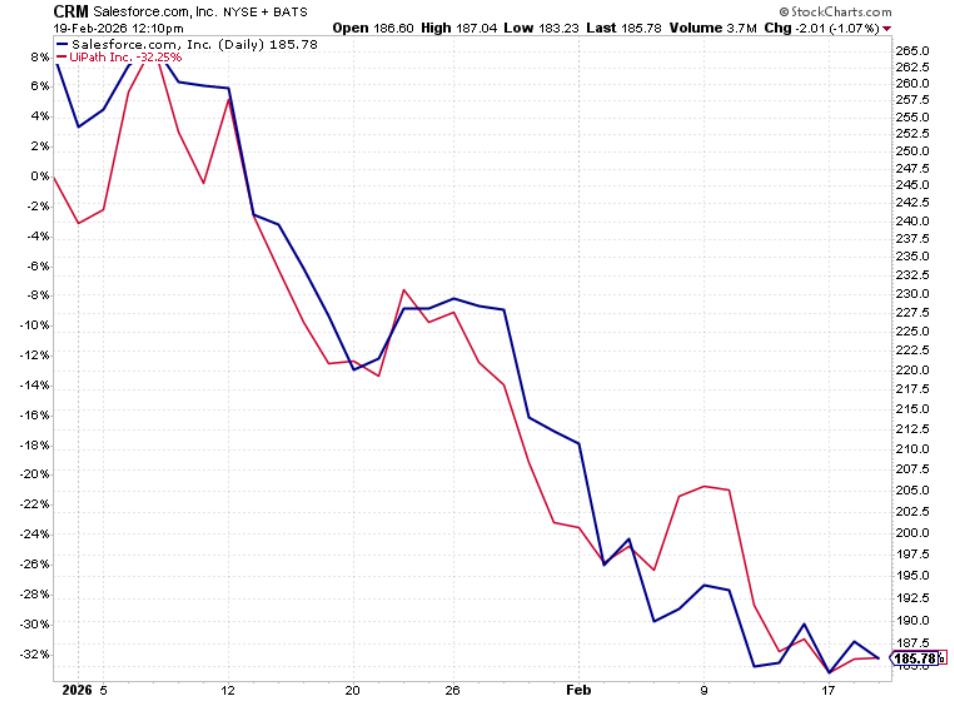
The labor-replacement engine has been turned on, and it doesn’t have an “off” button.
The New Wealth Equation: Energy, Compute, and AI Infrastructure
So, if the ‘Knowledge Economy’ is a sinking ship, where does the capital go? To find the winners of the Great Decoupling, you have to stop looking at the screen and start looking at the grid.
In the Old World, we invested in “people-first companies” – banks, service providers, retailers. In the New World, we must invest in The Infrastructure of Intelligence.
The intelligence explosion is fundamentally a physics problem. It requires two things in massive, almost incomprehensible quantities: Compute and Energy.
The math is staggering. A single query on a “reasoning” model like OpenAI’s o1 consumes roughly 10 times more electricity than a standard Google search. We are moving from the “Age of Bits” to the “Age of Electrons.”
Goldman Sachs estimates that AI will drive a 160% surge in data center power demand by the end of the decade. We aren’t just building computers; we are building “Information Power Plants” that require a constant, massive baseload of energy.
This is why the smartest money on the planet – the massive sovereign wealth funds and people like Ken Griffin – are stopping at nothing to lock up energy assets.
They are buying natural gas, the “New OPEC” of chips, the land and the transformers…
Because in a world where human labor is decoupled from wealth, the only things that matter are the things that power the machines.
If you own the electricity and you own the silicon, you own the future. If you own a “resume” and a “specialized skill set,” you own a relic.
The Rise of the Technological Republic: AI Job Displacement Becomes National Policy
We are told to “reskill” and “upskill.” But let’s be real: how do you “out-skill” a recursive algorithm that updates itself every 15 milliseconds?
You don’t.
The idea that we are all going to become “AI Prompt Engineers” is the modern equivalent of telling the 19th-century blacksmith that he should just become a “Steam Engine Whisperer.” Sure, a few people will do it. But most of the blacksmiths just went out of business.
The Great Decoupling is cold, efficient, and entirely indifferent to our feelings about “meaningful work.” It only cares about the cost per flop and the kilowatt-hour.
This is the essence of the Technological Republic – Palantir (PLTR) CEO Alex Karp’s vision for a new American era. No more hands-off, laissez-faire capitalism. This is a public-private iron pact to prioritize one thing: Critical Technological Dominance.
Importantly, this is also now a national security mandate. Our current administration is fully embracing this mindset with:
- Big investments in Intel (INTC), MP Materials (MP), Lithium Americas (LAC), Trilogy Metals (TMQ)… all companies mission-critical to the AI infrastructure buildout – because the first nation to fully decouple its economy from human labor and onto autonomous compute will be the global superpower for the next century.
- Project Stargate: the $100 billion supercomputer initiative.
- Genesis Mission: a Manhattan Project-scale initiative to dominate the next wave of AI, nuclear, and advanced manufacturing.
The government knows that the Great Decoupling is going to create a massive “Useless Class.” But stopping it would mean losing to China. Instead, its solution is to speed it up and ensure the United States owns the most powerful “replacement engine” on the planet.
In the Intelligence Century, second place is a death sentence. Better us than them, it figures.
How to Invest During the AI Labor Shift
If you’re waiting for the “labor market” to bounce back, you’re waiting for a ship that has already sunk. The opportunity today lies in moving your capital from the Victims of Decoupling to the Enablers of Decoupling.
That means you must sell the “Knowledge Toll-Booths” – the companies that sell human time and expertise – and buy the “Intelligence Utilities”: the companies that provide the raw materials for the silicon age.
We are talking about:
- Natural Gas: The only fuel capable of meeting the immediate, monstrous energy demand of AI data centers.
- Sovereign Infrastructure: The companies building the “Stargate” and “Genesis” projects that the government is backing with billions.
- Advanced Compute: Not just the chips, but the cooling systems and the power management hardware that prevents AI “brains” from melting.
The Great Decoupling is the most significant economic event of our lives. It is the end of the “Human Century” and the beginning of the “Intelligence Century.” You can either be the labor that is being replaced – or the capitalist who owns the replacement.
Now, here’s an even more uncomfortable truth: This transformation isn’t just economic. It’s geopolitical.
The U.S. government has made a decision: it will not slow AI down to protect jobs. It will accelerate it to win the AI Cold War.
Behind the headlines, Washington is mounting an attack, pouring billions into chips, energy, materials, and advanced compute infrastructure.
And when the government moves at that scale, it creates strategic winners.
I recently put together a special briefing breaking down the companies I believe are best positioned to benefit from this government-backed AI acceleration – firms tied directly to federal contracts, strategic partnerships, and national security priorities.
If you want to align your capital with the side that’s being funded – not the side being automated – you should see this now…
Because in the Intelligence Century, the government isn’t trying to stop the replacement engine. It’s building it.