AI Layoffs Are Spreading Faster Than Expected

What started in fintech is now hitting software, crypto, and banking – and accelerating
AI layoffs are accelerating – and they’re spreading across the economy.
Fintech. Enterprise software. Crypto. Now traditional banking.
Different industries, same message: fewer people are needed to do the same work.
Not long ago, we detailed Jack Dorsey’s 40% headcount cut at Block (XYZ) and argued it would go down as a crossing of the Rubicon – the moment AI moved from productivity talking point to pink slip.
Assuming the trend continued, we modeled a potential range of 8–13% structural unemployment for the U.S. economy, on par with the worst recessions of the last 100 years.
We warned that the cascade would start in fintech and spread outward from there, ultimately sweeping through the entire knowledge economy.
Well, it has been about three weeks since then.
And unfortunately, the pace is accelerating faster than we expected.
The AI Layoffs Scorecard: What Just Happened
Let’s take inventory of what has happened since we last discussed AI-driven layoffs because the landscape is changing swiftly.
On March 11, Atlassian (TEAM) – the Australian enterprise software giant behind Jira and Confluence – announced it was cutting 1,600 employees, with over 900 layoffs aimed directly at software research and development. CEO Mike Cannon-Brookes wasn’t quite as blunt as Jack Dorsey in his approach, but he came close:
“It would be disingenuous to pretend AI doesn’t change the mix of skills we need or the number of roles required in certain areas. It does.”
The market rewarded the move, with the company’s stock rising 1% after the announcement.
Now, it’s not like Atlassian is some struggling startup. Cloud revenue growth accelerated to 25%-plus, RPO growth is running at 40%-plus, and the firm counts more than 600 customers who spend over $1 million annually.
This is an already-healthy company choosing to be leaner.
Healthy Companies Are Cutting Anyway
Atlassian isn’t an isolated case. Many of the companies making these cuts aren’t under pressure – they’re choosing to operate differently.
Snowflake (SNOW) laid off its entire technical writing and documentation department.
The news followed the announcement of a $200 million partnership with OpenAI, which included an autonomous agentic platform capable of drafting complex API documentation directly from source code in minutes – work that previously required human teams weeks to accomplish. The department didn’t just get cut – it got replaced – by the very product the company provides.
If you wanted a cleaner illustration of the mechanism, you could not invent one.
This pattern continues to spread.
The Template Is Being Copied
The Winklevoss twins’ crypto exchange started the year with roughly 700 employees – and has spent two months systematically eliminating 30% of them. This line from their shareholder letter is likely to be remembered:
“AI is now too powerful not to use at Gemini. Not using AI at Gemini will soon be the equivalent of showing up to work with a typewriter instead of a laptop.”
Following suit, Crypto.com‘s CEO Kris Marszalek posted on X: “We are joining the list of companies integrating enterprise-wide AI. Companies that do not make this pivot immediately will fail.”
Unlike most corporate rhetoric, this one has real implications.
Now, here’s the headline that stopped the financial world in its tracks. Reuters reported, citing three sources familiar with the matter, that Meta (META) is planning sweeping layoffs that could affect 20% or more of the company. Meta employs nearly 79,000 people. Twenty percent is roughly 15,700 jobs.
Meta’s spokesperson called it “speculative reporting about theoretical approaches.” Wall Street called it a reason to buy; Meta’s stock climbed nearly 3% on the report.
The company that is allegedly about to lay off 15,000 people saw its market cap go up. The mechanism is playing out in real time. Dorsey set the template. Every CEO in America watched what happened to Block’s stock, and they are drawing the same conclusion.
Back in January, Zuckerberg himself said he was starting to see “projects that used to require big teams now be accomplished by a single very talented person.” That’s not a man who is going to defend a 79,000-person headcount for long.
From Tech to Finance: The Spread Begins
What started in tech is now moving into more traditional sectors, as we suspected.
Financial services firm HSBC Holdings (HSBC) is weighing deep job cuts over the coming years. CEO Georges Elhedery is looking to AI to shrink the company’s middle and back offices – one of the first signs of how the technology could reshape Wall Street workforces. The potential cuts could affect around 20,000 roles, or roughly 10% of the bank’s global headcount, over the next three to five years, targeting non-client-facing positions in global service centers.
Twenty thousand bankers. Compliance. Operations. Data processing. The unglamorous but enormous layer of human labor that keeps the global financial system running – increasingly automated.
And Goldman Sachs (GS) and Citi (C) are considering similar moves. Goldman’s CEO David Solomon has been talking about an AI-driven operating system called “OneGS 3.0” and has tightened performance criteria specifically in light of AI capabilities. Insiders say cuts could be announced as soon as April.
The Running Tally
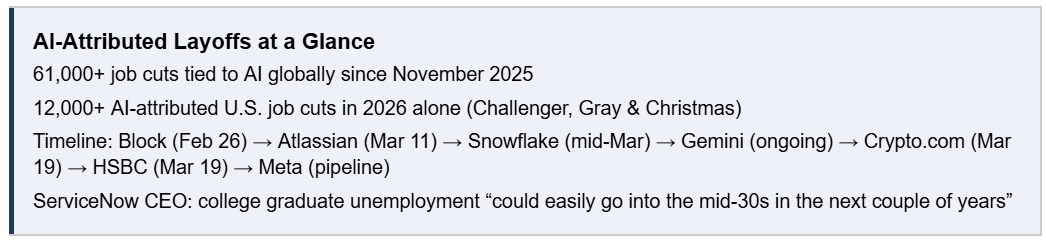
These numbers are still small relative to the 50 million-person knowledge economy we modeled.
The displacement has just begun. But the pace of announcement is accelerating, and the gap between “announcement” and “execution” is shrinking.
How the AI Layoff Wave Is Spreading Across Industries
The AI-driven layoff cascade we mapped just weeks ago is unfolding largely along the lines we outlined:
- Block — Healthy fintech business, explicit AI rationale, 40% cut. Stock up 24%.
- Gemini, Crypto.com, and adjacent fintech — Direct competitors and adjacent fintech firms followed.
- Atlassian / Snowflake — Enterprise software followed.
- HSBC — Traditional finance is now entering the fray; Goldman and Citi are reportedly next.
- Meta / Amazon — Mega-platform stage underway. Amazon already cut 16,000 in January. Meta is next. Alphabet and Amazon will likely follow suit.
We modeled 8- to 13% structural total unemployment as the range for full knowledge economy adoption of Block-style AI efficiency. We are still in the very early innings. What we are watching right now is the permission structure being established, the template being copied, the social license to cut expanding with each announcement.
The key distinction here is structural, not cyclical.
Every one of these announcements is a company explicitly saying it does not intend to rehire for these roles. Snowflake’s entire documentation team was replaced by software, not put on temporary leave. Atlassian is “reshaping its skill mix” — executive language for: these job categories are not coming back. HSBC’s plan spans three to five years and targets systematic automation of processes, not a headcount buffer for a bad quarter.
These workers are being structurally displaced.
‘AI-Washing’ vs. Real AI Layoffs: Why It Doesn’t Change the Outcome
The counterargument — and it is a real one, worth taking seriously — is “AI-washing.”
Skeptics argue that companies are using AI as narrative cover for cuts they would have made anyway: over-hiring during COVID, post-zero-interest-rate reality checks, pressure from activist investors and public markets. Last month, Sam Altman himself said that some companies are “blaming AI for the job cuts they would have made anyway.”
He’s right. Some of them are. Algorand cutting 25% when its token is down 98% has more to do with the crypto cycle than Claude. These things are not mutually exclusive, and untangling genuine AI displacement from COVID-hangover cost-cutting is genuinely hard.
But here is the thing: even if 50% of these announced cuts are AI-washing – pure financial rationale with AI as the PR veneer – the other 50% are real. Snowflake didn’t keep its documentation team and tell investors it was using AI. It eliminated the team because AI can do the work instead.
And more importantly: the AI-washing critique assumes that even the “fake” AI cuts won’t eventually become real. Companies that eliminate documentation teams to save money today, and then find that AI-generated documentation works adequately, do not hire those teams back when their stock recovers. The rationalization becomes the reality.
The AI-washing argument may explain the timing of some cuts, but it does not argue against the direction of the structural shift.
What AI Layoffs Mean for the Economy
We painted this picture three weeks ago, and nothing has changed. If anything, the recent data reinforces the underlying dynamic.
GDP grows. Markets rise. The ServiceNow CEO predicts 35% unemployment for new college graduates. All three will probably be simultaneously true. The dual economy is assembling in real time.
The AI infrastructure plays — the hyperscalers, semiconductor manufacturers, energy and data center builders who power the whole apparatus — are direct beneficiaries of these shifts.
Every time Block cuts 4,000 people and buys more AI tools, that’s compute spend. HSBC replacing 20,000 middle-office employees with AI represents more cloud, inference, and foundation model API spend. The labor savings don’t disappear – they get redirected into AI capital spending, which flows into the earnings of the companies building the infrastructure.
What we’re watching isn’t just a labor shift – it’s a reallocation.
From wages to compute. From headcount to systems. From people to platforms.
And as that transition unfolds, the center of gravity moves with it.
That’s where the next phase of this story begins – and where platforms like OpenAI’s sit.
While OpenAI is not yet publicly traded, expectations are building for what could eventually become one of the most important tech IPOs of this cycle.
But as we’ve seen time and again, by the time those IPO headlines hit, a large part of the opportunity is already priced in.
That’s why I recently recorded a briefing outlining a lesser-known way investors may be able to position themselves ahead of that moment… before the broader market fully catches on.
You can watch that briefing right here.